Culture Studies: The Incredible India Discovery Series
This series is intended to instill a sense of identity, pride and global citizenship through a deep understanding of Indian heritage. This matters because they develop :
Emotional Intelligence: Understanding different traditions fosters empathy and respect for diversity.
Analytical Thinking: Comparing different states and historical eras builds a strong “big picture” worldview.
Confidence in Roots: Knowing the history of their names, languages, and festivals gives children a strong sense of belonging.
Holistic Learning: We connect history to geography, geography to clothing, and clothing to climate—making learning a connected web rather than isolated facts.
Fun Fact: We designed a Cultural Passport and as they completed each module, they will receive a ‘Heritage Stamp’ and work towards graduating as Junior Cultural Ambassadors!
Some of the examples of our culture studies curriculum include:
| Theme | Topics | Core Topics & Learning Pillars | Activity/Project |
|---|---|---|---|
| Identity & Origins | 1. India: The Great Map | Indian States, Capitals, and Geographic Diversity (Himalayas to Oceans). | The Giant Map: Creating a physical map of India. |
| 2. Voices of India | Introduction to Major Languages (Hindi, Sanskrit, Tamil, etc.) and Scripts. | Name in 5 Scripts: Learning to write their name in different Indian scripts. | |
| 3. Pillars of Freedom | Historical Figures (Ashoka, Akbar) & Freedom Fighters (Bapu, Bose, Sarojini Naidu). | The Time Machine: Role-playing a famous speech from history. | |
| The Performing Arts | 4. Echoes of the Past | Classical Musical Instruments (Veena, Sitar, Tabla) and the concept of “Nada.” | Instrument Petting Zoo: Hearing and identifying sounds of some of the folk instruments. |
| 5. The Divine Dance | The 8 Classical Dance forms (Bharatanatyam, Kathak, etc.) & Mudras (Hand gestures). | Mudra Stories: Telling a whole story using only hand gestures. | |
| 6. Rhythm of the Soil | Regional Folk Dances, Festive Music, and community drumming traditions. | Beat of the Drum: Learning a simple rhythm on a Dhol or Ghatam. | |
| Living Traditions | 7. The Festive Calendar | Meaning behind major festivals (Holi, Diwali, Eid, Onam, Pongal). | Festival Journal: Tracking the moon phases for Indian festivals and learning about each festival. |
| 8. Threads & Textures | Traditional Clothing (Sari, Dhoti, Pheran) and the history of Indian Textiles (Khadi, Silk). | The Fashion Show with Indian costumes from various states. | |
| 9. Sacred Nature | Indian Sacred Trees (Peepal, Tulsi), Ayurveda basics, and the “Respect for Life.” | The Kitchen Pharmacy: Identifying 5 spices in a spice box. | |
| Wisdom & Play | 10. The Poet’s Corner | Legendary Poets (Kalidasa, Kabir, Tagore) and Modern Authors (R.K. Narayan) | Poetry Jam: Reading a “Doha” (couplet) or a short nature poem. |
| 11. The Artist’s Eye | Visionaries like Raja Ravi Varma & the philosophy of Indian Aesthetics | Gallery Walk: Analyzing a classical Indian painting for hidden symbols. | |
| 12. The Indian Arena | Traditional Sports (Kabbadi, Kho-Kho) and ancient games (Chess, Snakes & Ladders) | Game Day: A tournament of traditional Indian board games. |
Level | Category | Core Syllabus (Grammar & Vocabulary) | Practical & Cultural Integration |
|---|---|---|---|
| 1 | Introduction | The Basics: Introduction to Swar (vowels) and Vyanjan (consonants). Common nouns (Colors, Numbers 1-20, Animals, Fruits). | Songs & Rhymes: Learning simple children’s songs (e.g., Lakdi ki Kathi) to get used to the phonetics and rhythm of the language. |
| 2 | Beginner I | Sentences & Pronouns: I/You/He/She (Main, Tum, Aap, Yeh, Woh). Basic verbs (To eat, To go, To sit). Simple “A is B” sentences. | Greetings: Learning to introduce oneself, saying “Namaste,” and basic etiquette words (Thank you, Please, Sorry). |
| 3 | Beginner II | Everyday Life: Family relations, Parts of the body, Time, and Days of the week. Post-positions (In, On, To, From). | Social Interaction: Basic question words (Who, What, Where, Why). Learning to ask for directions or prices at a market. |
| 4 | Beginner+ | The Present Tense: Masculine vs. Feminine word endings. Present continuous (I am doing) and Habitual (I do) actions. | Describing the World: Using adjectives to describe people and places. Learning a popular Bollywood chorus to understand sentence flow. |
| 5 | Intermediate I | Past & Future: Talking about what you did yesterday or plans for tomorrow. Expression of “Want” (Chahiye) and “Can” (Sakta). | Storytelling: Describing a short sequence of events or a movie plot. Role-playing common scenarios like “At a Restaurant” or “At the Airport.” |
| 6 | Intermediate II | Colloquial Speaking: Common sentences, idioms, and fillers used. Using “Ne” with past tense (the most vital colloquial hurdle). | Fluency & Discussion: Having a 5-minute conversation on a favorite hobby. Understanding lyrics of meaningful songs and debating simple “This or That” topics. |
Equipping Young Minds with Timeless Tools for Modern Life
Class Duration: 30 Minutes Weekly | Focus: Character Building & Emotional Intelligence
The “Values & Wisdom Lab” is designed to help children navigate the world with a strong internal compass. Using the “Mirror of Wisdom,” we explore ancient epics, modern literature, and Vedantic philosophy to transform “Information” into “Transformation.”
Curriculum Overview
| Module | Core Value & Concept | The “Wisdom Snippet” | Story Anchor |
| I. The Hero Within | Bravery & Self-Belief | “Good people aren’t fearless; they are just brave for 10 minutes longer.” | Krishna & Kaaliya Snake / Harry Potter |
| II. The Art of Choice | Mind vs. Intellect | Choosing based on reason/logic (Intellect) rather than likes/dislikes (Mind). | Duryodhana’s Dilemma / The Lottery Ticket |
| III. The Happiness Lab | True vs. False Joy | “The Path of the Good” is difficult at first but rewarding in the end. | The Painter of Krishna & Kamsa / Ryan’s Well |
| IV. Relationship Magic | Love & Kindness | Love is understanding others as they are, not as we want them to be. | Krishna & Sudama / The Real Mother (Vikram-Betaal) |
| V. The Giving Tree | Law of Unselfishness | A life based on GIVING creates happiness; taking leads to suffering. | Bharat’s Sacrifice / Angad & Hanuman in Lanka |
| VI. Mental Mastery | Thought Power | “No one can destroy iron but its own rust. No one can destroy you but your own negative thoughts.” | Adi Shankaracharya / The Old Man’s Garden |
| VII. Success Mindset | Passion & Grit | Success requires doing the right thing at the right time with consistency. | Martin Luther King Jr. / The Bodyguard’s Sacrifice |
| VIII. Social Wisdom | Avoiding Herd Mentality | Think before you act; do not follow the crowd blindly. | Krishna’s Birth / Akbar & Birbal |
“Wisdom in Action” (Sample Homework)
- The Service Challenge: “Try to serve food to someone else in your family first, before putting it on your plate.”
- The Anger Audit: “Try not to get irritated for 3 days. Remember: The world will be irritating, but I should not be irritated.”
- The Quality Quest: “This week, follow the qualities of a hero: be brave, be helpful, and no back-answering.”
Why Vedanta for Kids?
“Vedanta means the Highest Knowledge—that which ends all sorrows.”
In our 30-minute weekly lab, we move beyond “Fools rush in where angels fear to tread.” We teach children to be the “Angels”—those who use their intellect to assess situations rightly and choose the Path of the Good over the Path of the Pleasant.
| Fun theme examples | Suryanamaskar Goal examples | Animal Poses examples |
|---|---|---|
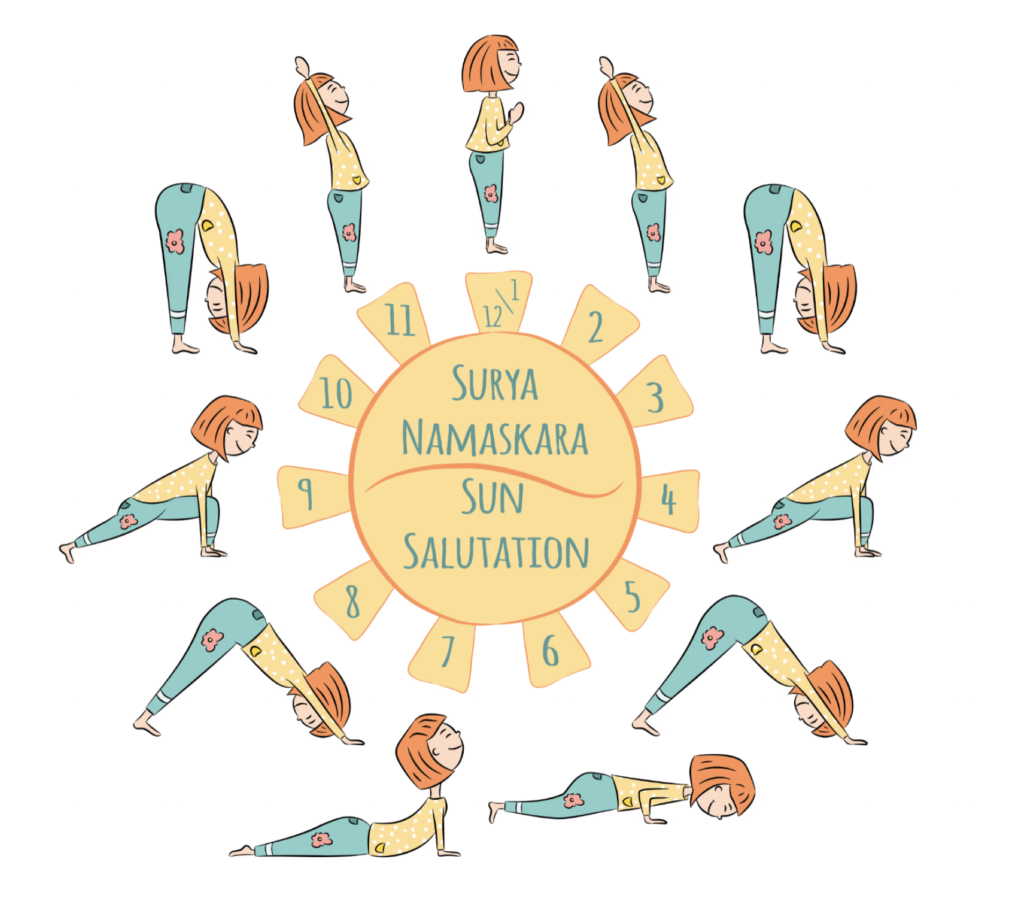
| The Little Seed | Learning the 12 steps of Sun Salutation as a slow-motion “story.” | Jungle Poses: Butterfly, Lion Breath, and Cobra. |
| The Tall Tree | Performing 3 rounds of Sun Salutation with “Super-Hero” breathing. | Balance Poses: Tree Pose (Vrikshasana) and Flamingo. |
| The Strong Warrior | Increasing to 6 rounds and holding the “Plank” (Mountain) position. | Strength Poses: Warrior I & II, and The Bridge. |
| The Flexible Cat | Doing Sun Salutations to the beat of music or a drum. | Flexibility Poses: Cat-Cow, Downward Dog, and Frog Jumps. |
| The Yoga Ninja | Performing 10 rounds of Sun Salutation and leading a “Quiet Time” (Savasana). | Confidence Poses: Airplane Pose and Bow Pose. |
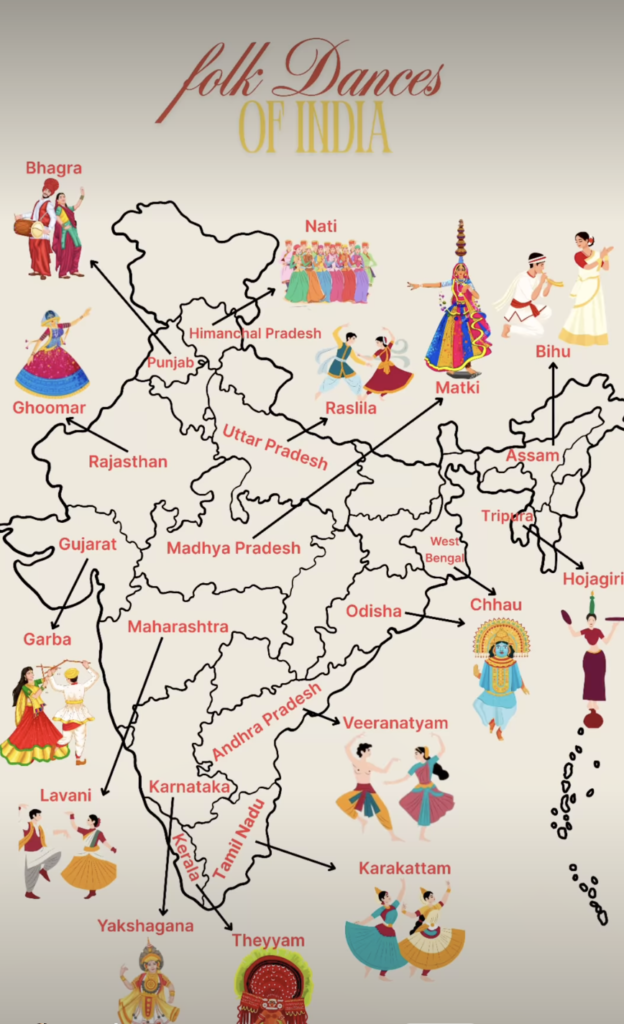
Pack Your Bags for a Rhythmic Journey! 🌏
Why stay in one place when you can dance across the map? Our Folk Dance Passport program takes children on a high-energy tour of India’s most vibrant cultures. From the powerful beats of Punjab’s Bhangra to the graceful swirls of Rajasthan’s Ghoomar, your child won’t just learn steps—they’ll discover the stories, festivals, and traditions that make our heritage so colorful. No experience needed, just a pair of dancing feet and a sense of adventure!
We believe children don’t just learn culture, but experience it. Our Folk Dance Exploration program takes children on a joyful journey across India, one state at a time, through dance, music, stories, and traditions.
Each month, children explore a different Indian state along with its dance, culture, festivals, and stories. This is not just dance class. Children learn why people dance during celebrations, harvests, traditions, and community.
| Dance Forms | Learning Pillars | Activity | |
| I. Gujarat: Circles of Celebration | Garba & Dandiya | – Circular dance forms as community bonding – Rhythm through clapping and sticks – Gujarati culture & music | Mini Navratri Celebration: Kids dance Garba/Dandiya in a decorated circle with diyas |
| II. Punjab: Energy & Expression | Bhangra & Giddha | – Expression through dance (face + body) – Rhythm tied to agriculture cycles – Punjabi culture & music | Harvest Dance Party: Kids dance Bhangra with props like scarves |
| III. Maharashtra: Rhythm & Expression | Lavani – Simplified | – Facial expressions and storytelling – Rhythm and tempo – Marathi culture & music | Story Through Dance: Kids act out a simple story using Lavani-inspired moves |
| IV. Rajasthan: Grace & Storytelling | Ghoomar | – Spins, grace, and posture – Expressive storytelling through dance – Rajasthani culture & music | Spin & Story Showcase: Kids learn a short Ghoomar sequence with storytelling |
| V. Tamil Nadu: Rhythm & Community | Kummi & Kolattam | – Clapping rhythms and coordination – Partner and group synchronization – Tamil cultural & music | Stick Dance Circle: Kids learn Kolattam choreography with simple sticks |
| VI. Assam: Nature & Joy | Bihu | – Dance inspired by seasons and nature – Playful expression and rhythm – Assamese culture & music | Spring Celebration Dance: Kids learn Bihu dance with nature-themed gestures |
| VII. Himachal Pradesh: Community & Flow | Nati | – Group synchronization – Slow, steady rhythm – Cultural unity | Circle of Friends Dance: Kids learn a Group Nati performance holding hands |
| VIII. Kerala: Grace & Devotion | Thiruvathira | – Graceful coordinated movement – Cultural rituals and symbolism – Kerala traditions & music | Lamp Dance Performance: Kids learn to dance around a “lamp” setup |
| IX. Odisha: Patterns & Precision | Sambalpuri Dance | – Pattern recognition in movement – Coordination and repetition – Odisha culture & music | Dance + Design: Kids create simple patterns and reflect them in dance steps |
| X. West Bengal: Drama & Movement | Chhau – Simplified | – Dramatic expression and poses – Storytelling without words – Mythological characters | Mythology Skit Dance: Kids perform a short Ramayana/Mahabharata scene |
| XI. Karnataka: Rhythm & Power | Dollu Kunitha – Simplified | – Beat and body coordination – Group rhythm patterns – Karnataka traditions & music | Rhythm Circle: Kids create beats using body percussion or simple drums |
| XII. Andhra/Telangana: Culture & Color | Lambadi Dance | – Expressive movement – Cultural identity through dance – Celebration and storytelling | Lambadi Dance: Kids learn a vibrant & expressive dance celebrating tribal traditions |
| Level | Group | Core Syllabus (Practical) | Musical Concepts & Focus |
| 1 | Beginner | Sarali Varisai, Janta Varisai, Upper Sthayi Varisai, Daattu Varisai, and Sapta Tala Alankarams with Akara Sadagams. | Focus on Shruti consistency, Swarasthana precision, and Laya (rhythm) across 3 speeds. |
| 2 | Beginner | All Pillar Geethams (at least 5-10), Beginner Swarajathis (e.g., Rara Venu), and Nottuswaras or Swara Pallavis. | Introduction to Sahitya (lyrics) pronunciation and basic Raga structures. |
| 3 | Beginner+ | Advanced Swarajathis (e.g., Samba Shiva) and initial 4 Adi Tala Varnams in two speeds. | Development of Raga Bhava (expression) in popular ragas like Mohanam and Kalyani. |
| 4 | Beginner+ | Total of 8 Adi Tala Varnams, 5 simple Kritis (Adi/Rupaka tala), and Semi-classical compositions (Bhajans/Abhangs). | Performance of fundamental lessons in Melakartha ragas other than Mayamalavagowla. |
| 5 | Intermediate | Introduction to Ata Tala Varnams (2), 20 total Kritis, and the first Thyagaraja Pancharatna. | Mastery of complex ragas like Keeravani, Sri Ranjani, and Poorvi Kalyani. |
| 6 | Intermediate | 3 Ata Tala Varnams, 35 total Kritis, 2 Pancharatnas, and introductory Manodharmam (Brief Alapana & Swarakalpana). | Introduction to creative improvisation in basic ragas like Hindolam and Pantuvarali. |
| 7 | Intermediate | Adi Tala Varnams in 3 speeds, 50 total Kritis (including Chowka Kala), and expanded Alapana/Swarakalpana. | Focus on varied Talas (Misra Chapu, Khanda Chapu) and ragas like Sahana and Anandabhairavi. |
| 8 | Advanced | 4 Thyagaraja Pancharatnas, 65 total Kritis (at least 4 in Chowka Kala), and Advanced Manodharmam with Neraval. | Identification of ragas and proficiency in complex rhythmic structures (Mukhtayis). |
| 9 | Advanced | Varnams in Tisra Nadai, Padams, Javalis, and Scholarly Kritis (Navavarna, Navagraha, Shyama Sastri Swarajathis). | Introduction to Ragam Tanam Pallavi (RTP) and scholarship in major ragas like Charukesi and Ranjani. |
| 10 | Graduate | Mastery of 100+ Kritis, Full RTP performance, Viruttams, Slokams, and Ragamalika Swaraprastharas. | Professional proficiency including Grahabhedam and concert-ready presentation style. |
From Mud Walls to Masterpieces! 🎨
Our Visual Folk Arts curriculum is a year-long exploration of India’s soul. We move beyond standard drawing to teach children the ancient languages of dots, triangles, mirrors, and stamps. Each month, students “travel” to a new state, master a unique tribal technique, and create a gallery-worthy piece of heritage art.
| Quarter | Month | Art Form | State | Key Skill for Children |
|---|---|---|---|---|
| Q1: The Magic of Lines | 1 | Warli Art | Maharashtra | Geometric Storytelling: Using triangles to draw people and movement. |
| 2 | Chittara Art | Karnataka | Grid Mastery: Learning to draw intricate patterns on a square grid. | |
| 3 | Kolam | Tamil Nadu | Flow & Focus: Creating “infinite loops” through a series of dots. | |
| Q2: Nature & Patterns | 4 | Madhubani | Bihar | Bold Outlining: Mastering the “double-line” technique and bright colors. |
| 5 | Gond Art | Madhya Pradesh | Pattern Filling: Using dots and dashes to create “textures” inside animals. | |
| 6 | Kalamkari | Andhra Pradesh | Organic Motifs: Learning to draw the “Tree of Life” and floral vines. | |
| Q3: Texture & 3D Art | 7 | Lippan Art | Gujarat | 3D Geometry: Working with clay (or dough) and mirrors to create relief art. |
| 8 | Rangoli (Sand Art) | North India | Color Blending: Learning how to shade and fill large areas with colored sand. | |
| 9 | Dot Rangoli | Pan-India | Math & Symmetry: Connecting dots to create perfect 6-point and 8-point stars. | |
| Q4: Stamps & Stories | 10 | Bagru block printing | Rajasthan | Block Printing: Using “found objects” (potatoes/sponges) to create repeat patterns. |
| 11 | Pattachitra | Odisha | Character Design: Learning to draw expressive eyes and traditional costumes. | |
| 12 | Phad Art | Rajasthan | The Grand Finale: Creating a mini “Story Scroll” on a long piece of paper. |
Coming Soon !! Stay Tuned !